
Beta. These courses are open and free to take while we test them. Tell us what works and what does not: take the 2-minute survey or email learning@nyopengov.org.
New York Coalition for Open Government › Learning Center

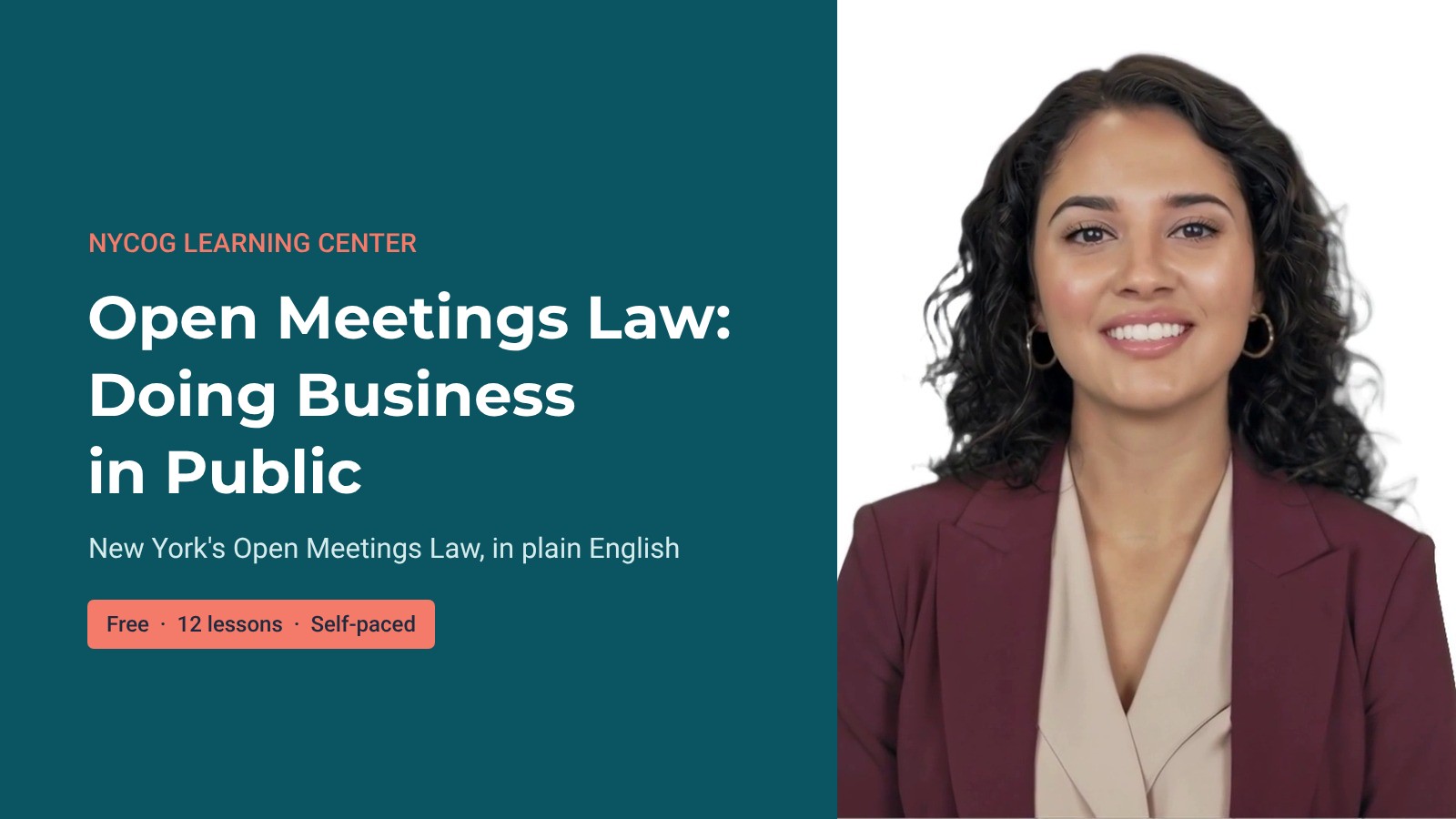
Open Meetings Law: Doing Business in Public

Categories: Open Meetings Law

About Course

New York’s Open Meetings Law, in plain English. For the trustee or clerk who runs the meeting and the resident who comes to watch it. In New York, the public’s business is supposed to be done in public. This course explains what that means in practice: which boards and committees the law covers, what turns a gathering into a meeting, how much notice the public gets, which documents have to be online before the meeting, what the minutes must contain and when, your right to record, how a board member can join by video, what an executive session is and is not, what the public can and cannot insist on, and what to do when a board gets it wrong.

Show More

What Will You Learn?

  • Tell which boards, committees and appointed bodies the law covers, and count a quorum correctly
  • Apply the two-question test that turns a gathering into a meeting
  • Give notice the law accepts: 72 hours, to the media, a posted place and the website
  • Get meeting documents online at least 24 hours ahead
  • Write minutes that satisfy the law and get them out within two weeks
  • Record a meeting, and know the conditions before a member attends by video
  • Move into executive session lawfully, with a motion that holds up
  • Set public comment rules that are reasonable and equal
  • Take the steps that work when a meeting does not follow the law

Course Content

Lesson 0: Welcome
Who the Coalition is, how the course works, and the one example we follow all the way through: a village board, a water rate study, and a work session at the diner.

  • Welcome
    03:39
  • Lesson 0 quiz

Lesson 1: Why this law exists
What the Open Meetings Law promises (the right to attend, observe and listen), how it grew from 1977 to today, and who does what: the Committee on Open Government advises, the courts enforce, the Coalition watches.

Lesson 2: Who has to follow it: public bodies, committees and the quorum
Which bodies the law covers: boards, their committees, and appointed groups that do a necessary part of the deciding. Purely advisory groups are not covered. Plus the quorum rule, vacancies included.

Lesson 3: What counts as a meeting
The two-question test: a quorum, and public business. Work sessions and planning retreats are meetings whatever they are called; site visits and social events are not, as long as nobody deliberates. No action by email or phone.

Lesson 4: Notice: 72 hours, and what “to the media” means
Notice: 72 hours for a meeting scheduled a week ahead, to the news media, a designated public place and the website, and what the notice must say when a meeting is streamed or uses video.

Lesson 5: Meeting documents: the 24-hour rule
The 24-hour rule: records to be discussed and every proposed resolution, law or policy must be available and online before the meeting. What is covered, what stays out, and why the packet the members get should be the packet the public gets.

Lesson 6: Minutes and recordings
What minutes must say, when they are due (two weeks, one week for executive session action), why drafts count, why a consensus is a vote, and where a posted recording fits.

Lesson 7: Your right to record, and meetings by video
Anyone may record an open meeting. The two kinds of videoconferencing, what a board must do before a member joins from home, how remote members count toward the quorum, and what the public is owed. Plus why we recommend livestreaming.

Lesson 8: Executive session: the essentials
How a board lawfully enters executive session: a specific motion in public, a majority of the total membership, one of eight reasons. Motions that fall short, what cannot happen inside, minutes afterward, and the exemptions, including the political caucus.

Lesson 9: Public comment, and what the public can insist on
The law does not require public comment, but it does require a room, a time and a place the public can use. Comment rules that hold up, where the Committee's guidance ends and our recommendations begin, and remote comment.

Lesson 10: When the law is broken, and what actually works
What a court can do when the law is broken, when attorney's fees are mandatory, and the steps that usually fix the problem before anyone goes to court.

Lesson 11: Wrap-up
The whole law on one card, the Coalition's ten-point pledge, where to get help, and the final exam.

Final exam
25 questions drawn from the whole course. You need 80 percent to pass, and you can take it as many times as you like.

Student Ratings & Reviews

No Review Yet
No Review Yet